Research note · Oct 13, 2026 · OraviaPeptide Team
Why Buy Peptides from China? A Guide to Price, Quality, and Suppliers
China is part of the global peptide manufacturing landscape. Understand the reasons buyers consider Chinese suppliers, the factors behind price differences, and the checks that help identify a suitable research peptide offer.
Why Buy Peptides from China? A Guide to Price, Quality, and Suppliers
Buyers searching for peptides from China usually want answers to three questions: why prices differ, whether the material meets their requirements, and how to choose a supplier they can work with.
China is part of the global peptide manufacturing landscape, with facilities supporting synthesis, research, and pharmaceutical development. For a laboratory, that creates sourcing options. The value of an individual offer depends on its specifications, analytical documentation, and delivered cost.
This guide explains the main reasons buyers consider China peptide suppliers and the details worth comparing before ordering.
Why Buyers Consider China Peptide Suppliers
Access to Established Manufacturing Capability
Peptide production involves synthesis, purification, analysis, and preparation of the final material. Buyers benefit from access to providers that can support the stages their project requires.
One historical example is WuXi AppTec's January 2024 announcement of new peptide manufacturing plants in Changzhou and Taixing. The company reported that the expansion brought its solid-phase peptide synthesis reactor volume to 32,000 liters. [1]
This illustrates the capability of a particular manufacturer. It does not establish the production capacity or quality standards of unrelated sellers.
For buyers, the useful question is which capabilities support the offered product: an established synthesis process, suitable purification, appropriate testing, or the ability to meet a defined specification.
Potentially Competitive Quotations
Price is another reason buyers investigate Chinese peptide manufacturers and suppliers. A shorter distribution chain, repeat production, or a larger order may help distribute commercial and production costs.
Those are possible contributors to a competitive quote, rather than a guarantee of lower prices. The savings should be assessed against equivalent specifications and the complete cost of receiving the material.
For a repeat purchase or a multi-product order, even a modest difference can matter. However, savings have little value if additional testing, delayed delivery, or a product mismatch prevents the laboratory from using the material as intended.
Options Beyond Standard Catalog Products
Some projects require a custom sequence, terminal modification, label, or peptide library. Published services from established providers such as GenScript demonstrate how peptide sourcing can extend beyond ready-made catalog items. [2]
For standard products, choice still matters. A buyer may need a particular salt form, quantity, or documentation package. Confirming those requirements early helps narrow the supplier search.
Custom capability should be assessed for the individual project. A general service description does not establish that every sequence can be produced at the requested purity, quantity, or schedule.
Why Are Some Peptides from China Cheaper?
An advertised price can combine—or exclude—several different costs:
| Cost factor | Why quotations may differ |
|---|---|
| Synthesis | Sequence complexity and production yield affect the work required |
| Purification | Different acceptance criteria can require different processing |
| Testing | The analytical panel and supporting reports may differ |
| Order quantity | Setup costs may be distributed across a larger order |
| Packaging and distribution | Bulk material, filled vials, and local warehousing involve different services |
| Freight and support | Delivery arrangements and quality resolution terms affect the complete offer |
A lower quotation may represent an efficient supply arrangement. It may also represent a different specification or fewer included services. Ask which explanation applies.
For example, two listings labeled “10 mg” may use different quantity definitions. One could refer to gross powder mass, while another refers to a stated amount of target peptide. They should not be treated as equivalent without clarification.
Local stock can also be worth a higher price when a laboratory needs fast access or easier replacement. Compare the service you require alongside the material.
Are Peptides from China Good Quality?
Country of origin does not determine whether a particular batch is suitable for your experiment. Evaluate the material against the requirements of the project.
Three attributes deserve separate attention:
- Identity: Is the analytical evidence consistent with the intended peptide?
- Purity: What does the selected method show about the impurity profile?
- Content: How much peptidic material or target peptide is present?
Bachem's quality-control guidance distinguishes chromatographic purity from net peptide content. Non-peptidic components such as water and counterions can affect the composition of the powder without being represented by the same purity measurement. [3]
Look Beyond a Purity Percentage
HPLC or UPLC results describe chromatographic behavior under a defined method. Mass spectrometry provides evidence about molecular mass. Quantitative analysis addresses amount.
A high purity result alone does not verify vial content, sterility, endotoxin levels, or biological activity. The appropriate testing depends on what the laboratory needs to establish.
Request the applicable batch report and clarify its scope. For a practical explanation of the terminology, see How to Read a Peptide COA.
How to Choose a Peptide Supplier in China
Establish Who Is Responsible for the Material
A seller may be a manufacturer, a sourcing intermediary, a distributor, or an inventory holder. Each arrangement can be useful, but the responsibilities should be clear.
Ask who manufactures the material, who performs analysis, and who handles a specification discrepancy. A “factory-direct” slogan does not answer those questions.
For a distributor, the ability to obtain accurate technical information and connect the supplied lot to its documentation is particularly important.
Match the COA to the Offered Batch
Confirm that the product name, variant, and lot identifiers refer to the material being supplied. Where bulk material is filled into smaller containers, ask how the packaging lot relates to the tested batch.
Determine whether the report describes bulk powder or a finished vial. Bulk identity and purity testing do not automatically establish finished-container quantity or uniformity.
Define Your Requirements Before Requesting a Quote
A useful inquiry includes the peptide name, quantity, destination, and any required material or analytical specification.
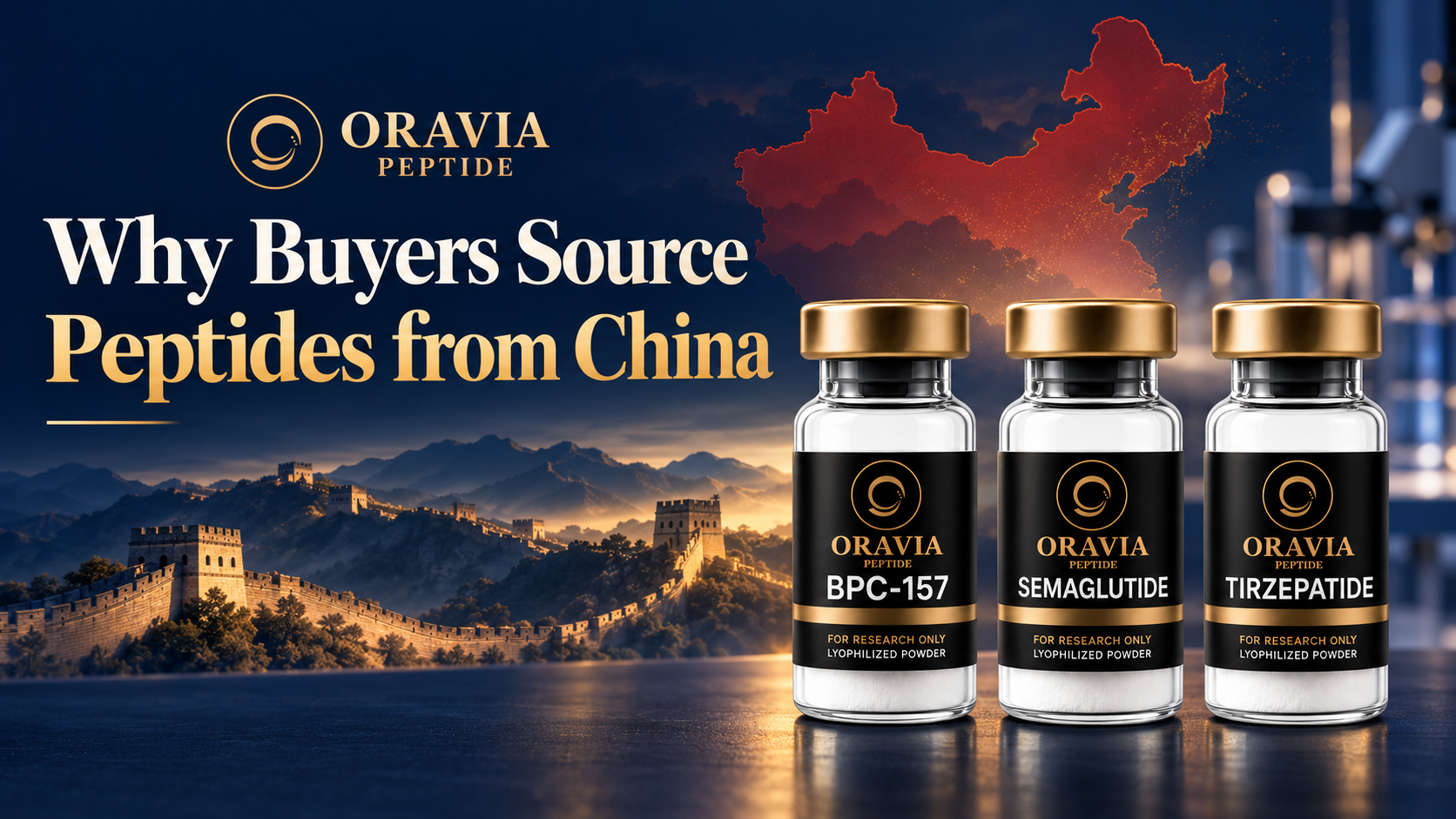
For BPC-157, Semaglutide, or Tirzepatide, use the exact product description rather than assuming every offer under the same name is identical. Compare the stated material, quantity basis, and supporting documents.
This approach gives suppliers a clearer request and helps you assess their responses on the same terms.
Research Peptide Options from Oravia Peptide
If BPC-157, Semaglutide, or Tirzepatide is on your procurement list, you can explore the corresponding Oravia Peptide product details while applying the checks above.
Start with the product specification, then ask about the quantity options, documentation, and dispatch information applicable to the offered batch. This keeps your comparison focused on the material your project needs.
Manufacturing Origin and Shipping Location Are Different
A peptide made by a vetted source may be stored in another country. A locally based seller may distribute imported material. The location shown on a website does not establish either the production site or the dispatch warehouse.
Before purchase, confirm:
- The manufacturing origin, where relevant to your procurement requirements.
- The location from which your order will be dispatched.
- Whether the material is in stock or requires production.
- What the quoted lead time includes.
- The packaging and storage arrangements appropriate for the material.
For international delivery, check the applicable import requirements for the material, destination, and intended use. A research-use label does not itself establish permission to import.
Compare Delivered Value, Not Just the Listing Price
A useful comparison includes the product price, freight, applicable charges, and any verification your laboratory must arrange.
Also consider what happens if the supplied material does not meet an agreed specification. Clear terms for documentation review and quality complaints can matter as much as a small price difference.
Before accepting an offer, make sure you can answer:
| Question | What to establish |
|---|---|
| What am I buying? | Exact material description and quantity basis |
| Which evidence applies? | Relevant batch COA and supporting data |
| When can it be supplied? | Stock or production status and delivery arrangements |
| What is the complete cost? | Product, freight, applicable charges, and additional testing |
| How will a discrepancy be handled? | Responsible contact and agreed resolution process |
These checks apply to suppliers in any country. They help turn an attractive price into an assessable purchase.
Frequently Asked Questions
Why do buyers purchase peptides from China?
Potential reasons include competitive quotations, access to manufacturing and synthesis services, and a wider choice of suppliers. The benefit depends on the specific product and offer.
Are Chinese peptides always cheaper?
No. Compare the same material specification, quantity basis, testing scope, and delivered cost. Different service packages can explain part of the price difference.
Does a COA prove that a peptide is genuine?
A relevant COA supports evaluation, but its value depends on the methods, results, authenticity, and connection to the supplied material. Review supporting data and traceability when needed.
Is third-party testing enough?
External testing can add independent evidence about the submitted sample. It does not automatically establish that the sample represents every supplied unit or that the delivered material remained unchanged.
Can research peptides be used as medicines?
Research material should not be treated as an approved medicine. Purity results and batch documentation do not establish clinical safety, therapeutic effectiveness, or regulatory approval.
Request Details for Your Research Project
Buying peptides from China can offer useful sourcing options when the specifications, documentation, and delivery terms match your requirements.
To compare an Oravia Peptide offer, contact us with the product name, required quantity, and destination. Ask for the applicable product specifications, batch documentation, quotation, and dispatch details.
For laboratory research sourcing. Not for human or veterinary use.
References
- WuXi AppTec. WuXi AppTec Triples Peptide Manufacturing Capacity and Launches the New Taixing API Manufacturing Site. January 8, 2024. Historical company announcement.
- GenScript. Custom Peptide Synthesis and Library Services.
- Bachem. Quality Control of Amino Acids & Peptides: A Guide.
For research use only. This catalog is for qualified laboratory and wholesale inquiries. It is not a consumer pharmacy and is not offered as an FDA-approved medicine.